
Williams County VINELink Coverage
VINE means Victim Information and Notification Everyday. The Ohio service works through VINELink. The Corrections Center of Northwest Ohio expressly participates, so a Williams County booking held at CCNO can appear through the participating regional custody source. ODRC records are also within Ohio VINE coverage. The Ohio Attorney General states that county jails, ODRC, and the Department of Youth Services take part.
Coverage follows the agency record, not the county name alone. CCNO serves Defiance, Fulton, Henry, Lucas, and Williams counties. Match the facility, agency, name, age, and any identifier before opening a result. A person transferred from CCNO to ODRC may generate a transfer event and later appear under state corrections. That transfer is continued custody, not community release.
| Custody system | VINELink role | Confirm with |
|---|---|---|
| CCNO regional jail | Custody search and local custody-change events | CCNO release record and court |
| ODRC prison | State status and listed notification events | ODRC offender detail and APA |
| Federal or USMS | Not covered as a federal locator | Federal docket, USMS, or BOP |
| ICE detention | Not a substitute for ICE ODLS | ICE locator and information line |
Search Williams County VINELink Records
Use the Ohio state portal for one specific person. Start with the most exact details available. A partial name can create several plausible matches, and a common name is not enough to identify someone. Keep the CCNO booking number, ODRC number, date of birth, or court case number nearby when known.
- Open the Ohio VINELink portal and select the person or custody search.
- Enter first and last name or the identifier allowed by the current form. Try an alternate spelling only if the first search fails.
- Compare the agency, facility, name, age, and identifier. For CCNO, check whether the record relates to the Williams County case.
- Open the closest match and preserve the exact event wording. “Transfer,” “escape,” “death,” and “general release” are distinct events.
- If the result conflicts with CCNO, ODRC, or court data, contact the custodian and request the underlying release or transfer record.
The live Ohio specific-person search is the source behind the interface shown here.
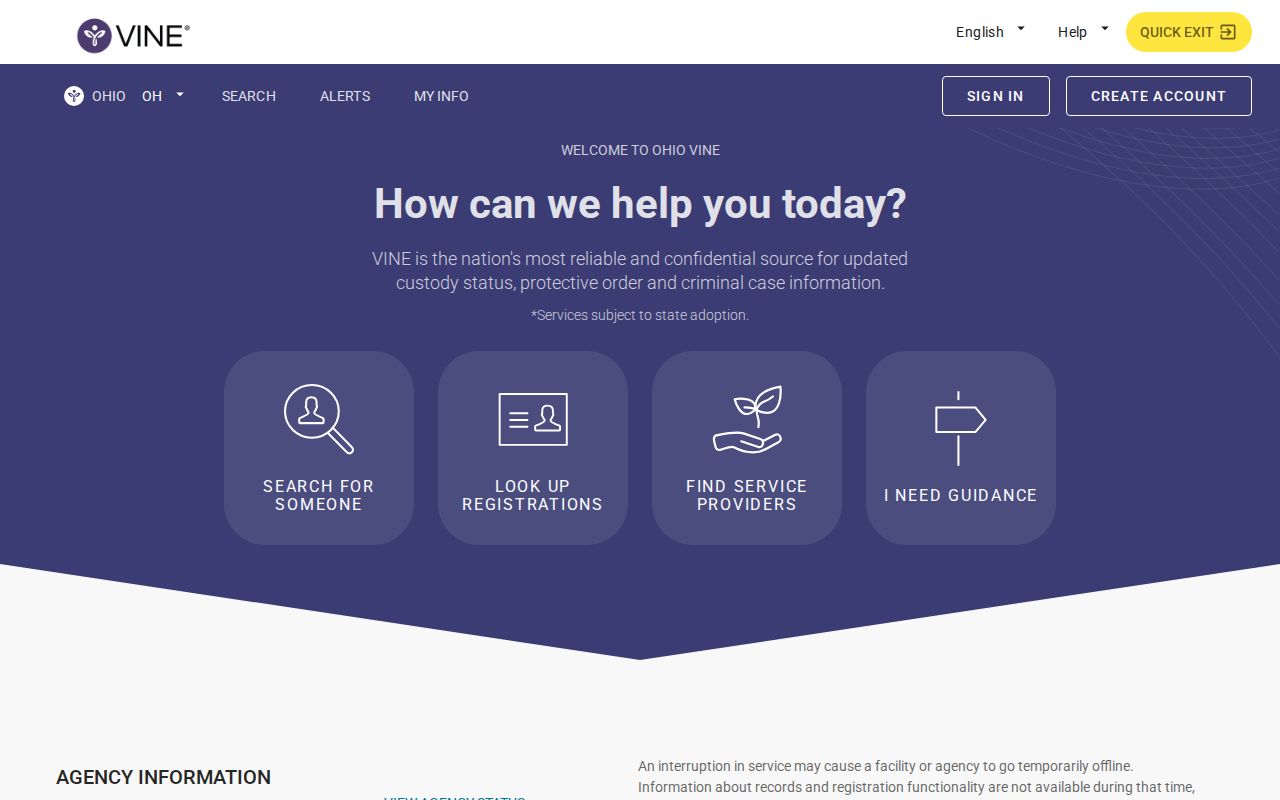
The portal can change labels, so follow the current screen and verify any match through the agency named in the result.
Williams County VINE Release Fields
VINELink reports what a participating custodian supplied. A result may state current custody, released or out-of-custody wording, the facility, an identifying number, and a reported event. Visibility varies. Treat each label as written. VINE is not an archive guaranteed to retain every person once custody ends, and a no-result does not establish release.
| Field or event | What it can establish |
|---|---|
| Name and identifier | Helps distinguish the intended person from similar names. |
| Agency or facility | Shows which participating custodian supplied the record. |
| Custody status | States the most recent status reported to VINE. |
| General release | Signals that the reporting custodian sent a release event. |
| Transfer | Shows a move, not freedom from custody. |
| Notification option | Allows registration for events offered on that record. |
County-jail events can include general release, transfer, escape, and death. ODRC events are broader. They may include prison transfers, parole-hearing notices, parole revocation or return, release from parole, Transitional Control Review, and IPP eligibility hearings. Do not reduce every alert to “released.”
A scheduled parole hearing notice is prospective. It says a review is planned, not that the Board granted release. Even a grant can have a later effective date, conditions, or an intervening change. A parole revocation or return event concerns someone who had already left prison under supervision and may now return to custody. Preserve that sequence when discussing a Williams County record.
Register Williams County Release Alerts
Register while the person is in custody. The Ohio Attorney General brochure describes registration during custody, so VINELink should not be treated as an indefinite former-inmate archive. Registration is confidential. Williams County's victim-rights material says jail or prison release and escape notices may arrive by text, call, or email, depending on the offered channel.
- Open the correct person record and choose “Register for Notifications.”
- Select phone, email, text, or another method offered on the current screen. Enter the destination with care.
- For a phone notice, create the requested four-digit PIN. Enter it when the automated call arrives to confirm receipt and stop retries.
- Complete any email or text confirmation shown by the portal. Keep registration details private.
- Add another personal contact method if needed, and update the registration when contact details change.
If no one answers a call, VINE can leave a message and retry until the PIN is entered or for up to 48 hours. Calls may arrive overnight. Multiple phone numbers and email addresses can be registered, and email registration has no PIN. Do not use a switchboard number because an unrelated person may receive the call.
For a forgotten PIN, call 1-800-770-0192 and select option 0. The Ohio brochure describes representative access around the clock. For immediate danger, use emergency services rather than waiting on a database notice.
A caller should choose a PIN that can be recalled but is not easy for another person to guess. Entering it tells the system that the notice reached the registered recipient and stops repeat calls for that event. Email has no PIN, so complete any link or confirmation step shown on screen. Re-register if a number or address changes. VINE cannot deliver a notice to an obsolete contact method.
Confirm Williams County VINE Events
A VINE event is corroboration, not the final record. Feeds may lag. Search again with the known identifier and correct agency if no result appears. For a CCNO event, compare the active and historical searches, the Williams County court journal, and the release packet. For an ODRC event, read the offender detail and any APA fields. The broader named-person workflow appears on the Williams County release search.
A federal detainee can leave CCNO and remain in USMS or BOP custody. Use the federal docket and BOP locator. ICE has its own detainee locator. Likewise, a person who transfers from CCNO to ODRC remains confined even though the regional jail record closes.
For a sentenced federal person, BOP's locator updates daily and may show a past release date with location “RELEASED.” That means BOP no longer holds the person, though another custody or supervision duty can remain. USMS has no comparable public released-prisoner locator. Before BOP designation, use the federal docket and appropriate USMS contact. For immigration custody, ICE ODLS covers current detainees and people released within the prior 60 days. Its narrower window makes an old no-result weak evidence.
A released person will often vanish from CCNO's active report. That is expected because the report is a current-population list. The historical CCNO interface may locate the booking, but its archive depth is not promised. A Williams County court entry can show the bond, dismissal, sentence, or judicial order, while the CCNO packet gives the physical departure time. Use VINE as one event source within that record chain.
Williams County VINE Notification Layer
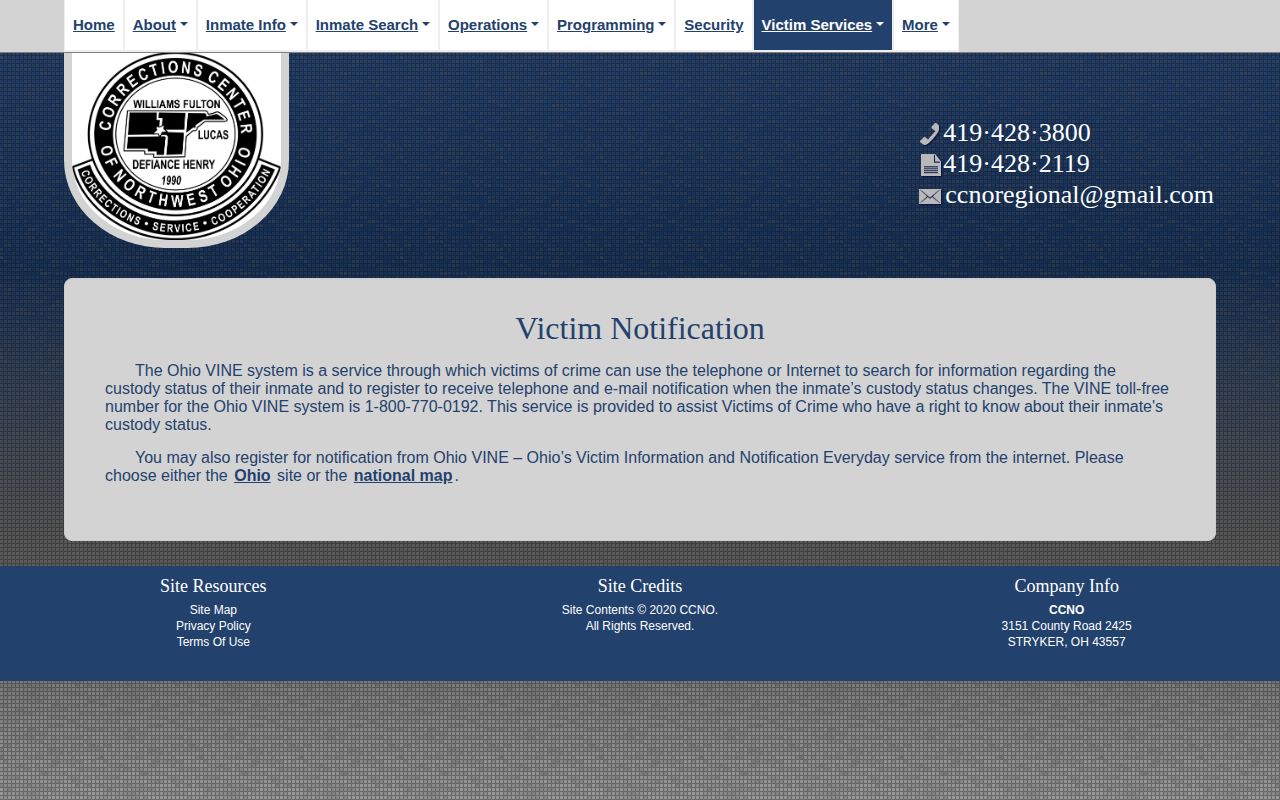
CCNO supplies an unusually clear local connection to Ohio VINE. Its victim-notification page names the service, posts the dedicated 1-800-770-0192 number, and links to web registration. That local source confirms participation instead of asking a user to infer it from a national portal.
The CCNO VINE page is shown in the captured view below.
Williams County's separate victim-rights page reinforces that release or escape notice may use a call, text, or email. Use the record's offered methods and retain the confirmation details.
VINE warns users not to depend on notification alone for safety because release may already have taken place by the time a message arrives. Registration does not change the release decision, create a hold, or supply the court's conditions. Preserve the notice time and event label, then follow the named agency for confirmation.
The Ohio sex-offender registry is a separate system. It can display post-release registration information only for people who have a statutory registration duty. Registry presence does not prove current custody or the time of CCNO release, and the absence of a person does not answer the general custody question.
Williams County VINE Event Meanings
Ohio VINE does not reduce every custody change to the word release. For a participating county or regional jail, the event may be a general release, transfer, escape, or death. Those outcomes call for different follow-up. A transfer from CCNO can lead to ODRC, another county, a federal custodian, or an immigration holder. It must not be reported as freedom in the community. A court entry and the CCNO release packet identify the legal authority and destination more reliably than a short alert label alone.
State-prison notifications can cover more than departure from an institution. Ohio materials describe prison transfers, parole-hearing notices, parole revocation or return, release from parole, and certain program or eligibility events. A hearing notice is prospective. A revocation event concerns supervision after an earlier prison release. Match each notice to the current ODRC status and the Williams County sentencing record before drawing a conclusion.
Registration is meant to occur while the person is still in custody. VINELink is not promised as a permanent archive of everyone once held at CCNO or ODRC. If the desired record no longer appears, preserve any alert already received, check the originating agency, and request the release record. That sequence keeps notification evidence separate from certified custody and court records.