
Understanding Williams County Releases
A release is a recorded end to one custody episode. It is not just a missing name. For a Williams County arrest, the key local custodian is the Corrections Center of Northwest Ohio, known as CCNO. This regional jail sits in Stryker and serves Williams along with Defiance, Fulton, Henry, and Lucas counties. Its current report mixes people from those jurisdictions and may include federal detainees. The Court and Arresting Agency fields are therefore vital. They show whether a booking belongs to a Williams County case or another authority.
When CCNO closes a booking, a person drops from the active population report. The reason may be bond, recognizance, dismissal, time served, sentence completion, or another court order. Yet the same change can mark transport to an Ohio prison, another county, a federal custodian, or immigration custody. Death also ends a custody entry but is not a community release. Confirm the event with the CCNO release packet and the court order. If another agency received the person, follow that agency's record next.
Williams County Release Types
Release terms describe different legal outcomes. They should never be collapsed into one label. Bond and recognizance end physical jail custody while the case continues. A dismissal or acquittal ends the charge in the court record, though the historical booking may remain. Time served and sentence expiration mean the local term has ended. Community control is an Ohio court sentence served under local supervision. Parole and post-release control concern release from state prison under ODRC authority.
| Release type | What it means | Where to check next |
|---|---|---|
| Bond or recognizance | The person leaves CCNO while the case remains open. | Court docket and local pretrial terms |
| Time served or sentence end | The local jail term is complete. | CCNO release packet and sentencing entry |
| Dismissal or acquittal | The charge ended without a conviction, though another holder may apply. | Court journal and CCNO record |
| Community control | The court allows a sentence in the community under local rules. | Williams County docket and Adult Probation |
| Parole or post-release control | The person left Ohio prison under APA authority. | ODRC offender detail and APA |
| Transfer or holder | The person left CCNO but remains in another agency's custody. | ODRC, receiving jail, USMS, or ICE |
Probation, also reflected in Ohio court records as community control, is local court supervision. Parole is conditional release from an eligible prison term. “Discharge” often means the end of the full prison or supervision relationship, not merely the day someone left a cell. A detainer is a request by another authority to hold or receive the person. These terms explain why one name can disappear from a local roster yet appear as incarcerated or supervised elsewhere.
Williams County Bond Release Status
Williams County Common Pleas Adult Probation runs a pretrial release and bond program for eligible people awaiting sentencing. A court can require reporting, no contact with named people, or other limits. This is release from the jail setting, but it is not the end of the criminal case. The person remains subject to the bond order, and the court docket is the best source for its terms.
Read the CCNO departure record beside the court entry. The judge's order gives the legal basis for release. CCNO supplies the physical departure time after staff finish identity checks, examine any holds, and return authorized property. If another warrant or holder applies, a bond order in one case may not produce a community release. The Williams County pretrial program description explains the local supervision role, while the individual docket controls each case.
Does release on bond mean the charges ended? No. It means jail custody ended under conditions while the court case continued. Later docket entries show what happened to the charges.
Williams County Release Statistics
CCNO's numbers describe the whole regional facility, not Williams County alone. The official 2025 facility statistics report 4,602 bookings and 4,520 releases, with an average daily population of 560. The jail had 576 funded beds and an average stay of 35.74 days. None of those figures may be divided or treated as a Williams-only release count.
The regional scale matters during a Williams County released inmate lookup. In separate population statistics, CCNO reported a 2025 Williams County average daily population of 46 and a Williams allocation of 55 funded beds. Those are population and capacity facts, not counts of people released. Always keep the source label and measurement period with a number.
Note: All release totals above cover the five-county regional center and must not be presented as Williams County-only totals.
Williams County Release Record Fields
A strong Williams County release record connects one person to one CCNO booking and explains how that custody ended. Name alone is not enough, especially when spellings, aliases, or repeat bookings overlap. Ask for the booking number, the court and case number, both custody timestamps, the release type, and any public transfer destination. The court record then supplies the legal order behind the event.
| Field | What it shows |
|---|---|
| Name, aliases, and identifier | Links the record to the correct person and distinguishes similar names. |
| CCNO booking number | Ties the release to one specific admission rather than another stay. |
| Admission date and time | Marks when the custody episode began. |
| Arresting agency, court, and case | Identifies the Williams County or outside jurisdiction that controlled the matter. |
| Release date and time | Records when CCNO physically ended that custody episode. |
| Release type or disposition | Distinguishes bond, time served, court release, sentence end, or transfer. |
| Authority, hold, or destination | May show who ordered the release or which agency received the person, when public. |
| Property receipt and photograph | Connects stored property and the booking image to the same CCNO number. |
A court journal date and a jail departure time can differ. Record both as labeled. A judge may sign an order before jail staff complete discharge steps, and a holder can delay or redirect departure. Protected medical, witness, investigatory, security, Social Security number, and other exempt material may be redacted from a packet.
Property After a Williams County Release
CCNO says booking staff inventory personal property, issue receipts for inmate money, and place clothing in a property bag. That record gives a released person a practical way to identify what was accepted at intake. When an item or balance appears wrong, contact CCNO with the booking number and any receipt. The research did not find a published deadline for ordinary community-release property pickup, so no deadline should be assumed.
The rules are more specific for transport to state prison. CCNO says most male ODRC transferees first go to the Correctional Reception Center in Orient, while female transferees first go to the Ohio Reformatory for Women in Marysville. CCNO does not transport their money or personal property. It directs a person awaiting transport to authorize pickup, keeps remaining property while staff try to reach a family member or friend, and disposes of it after 60 days. Prescription medicine is held 30 days, and an undeliverable trust-account check is held two years before transfer to the inmate trust fund. Those transfer rules should not be applied automatically to an ordinary community release.
The CCNO booking description is the source for intake inventory and receipts. It supports a focused property inquiry tied to the exact booking rather than a general claim about what the jail held.
Note: Keep the booking number and property receipt together because CCNO houses people for five counties and other authorities.
Request Williams County Release Records
CCNO is the main source for the jail custody and release packet. The CCNO public-record request policy accepts requests by email at ccnoregional@gmail.com, by mail or in person at Public Records Request, CCNO, 03151 County Road 2425, Stryker, OH 43557, and by phone at 419-428-3800 extension 201. In-person records hours are Monday through Friday, 8:00 a.m. to 4:00 p.m. CCNO lists $0.25 for each single-sided letter-size copy and says responsive copies will be available at cost within a reasonable period. Electronic delivery can reduce paper, but it is not promised to be free.
- Give the full name, aliases, date of birth if known, CCNO booking number, and an approximate booking date.
- Ask for admission and release or transfer timestamps, release disposition, releasing authority, public hold or destination data, property receipt, and booking photograph.
- Request electronic copies and ask the office to identify the legal basis for any withheld or redacted portion.
- Compare the response with the Williams County or Bryan court entry. If the Sheriff created a separate arrest, incident, or transport record, request that item from the Sheriff.
Sheriff Thomas Kochert's Williams County office accepts records requests at 1425 E. High Street, East Annex, Bryan, OH 43506, from 8:00 a.m. to 4:00 p.m. on weekdays except county holidays, or by email to wcso@bright.net. The phone is 419-636-3151. The Sheriff lists $0.10 per recorded-document page and separate video production fees. Those Sheriff rates do not replace CCNO's fee for CCNO-created records.
The Williams County Sheriff policy pictured below shows the local request route and the Public Records Act basis.
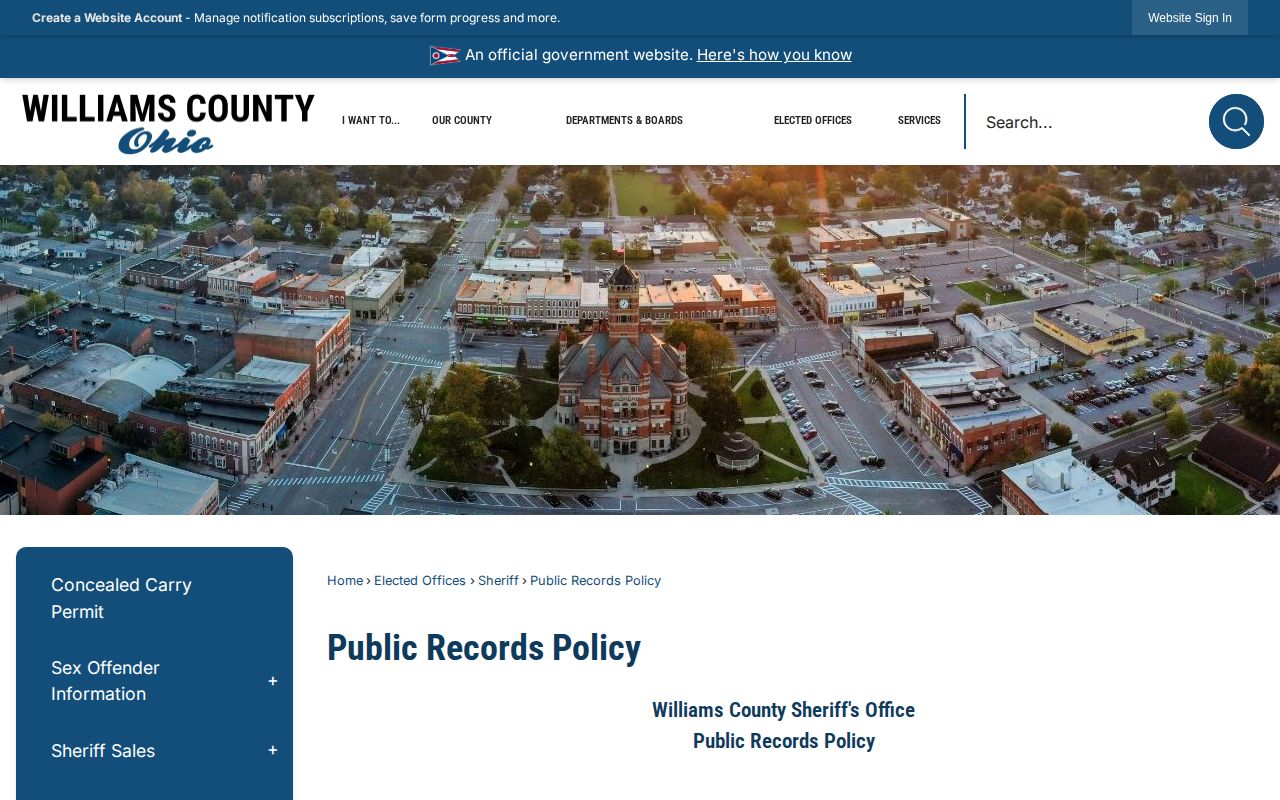
The screenshot helps locate the request rules, while the current office page and the custodian's response control the actual request.
Williams County Release Record Laws
Ohio Revised Code 149.43 requires a public office to make nonexempt public records available for prompt inspection and to provide copies within a reasonable period at cost. A request must describe the sought record fairly. “Reasonable” depends on the facts, so neither the statute nor the CCNO page creates one fixed turnaround for a release packet. An office may redact protected content and should identify the legal basis for a denial or redaction.
Retention online is a different issue. CCNO does not promise how long a former booking stays searchable. The underlying release and court records follow the custodian's retention and access rules even after a name leaves a web list. Full ODRC inmate and APA files have a special confidentiality rule under ORC 5120.21, so county-jail access does not open a complete prison or supervision file.
Ohio sealing and expungement depend on eligibility and a court order. ORC 2953.32 addresses eligible conviction records and exclusions; related statutes set timing and cover dismissals, acquittals, and no-bills. Sealing generally removes a case from ordinary public access. Expungement has stronger destruction effects, subject to legal exceptions. Neither result should be assumed to erase every jail item, private archive, or news report. Give the order to the court and CCNO and ask how it applies to the specific record.
Note: Juvenile, sealed, medical, victim, security, and protected investigatory information may follow access rules different from an adult release record.
Find Williams County Released Inmates
Start with custody type, not a broad name search. A local CCNO booking, an Ohio prison commitment, and a federal placement leave different records. The full Williams County released inmate search follows the chain from booking through disposition and then checks the agency that received the person. This prevents a transfer from being reported as a community release.
- Use CCNO's named historical search with first and last name. Add the booking number and date range when known.
- Compare that result with the active-offender report. A historical hit and no current listing suggest the booking closed, but do not show why.
- Read the Court and Arresting Agency fields. Select the Williams County, Bryan Municipal, outside-county, or federal docket that matches them.
- Inspect journal entries for bond, dismissal, sentence, community control, prison commitment, or judicial release.
- Search ODRC after a prison sentence, BOP after federal sentencing, or ICE when immigration detention is at issue.
- Use Ohio VINE as a custody-change check, then ask CCNO for the release packet when exact time, type, or destination matters.
The CCNO named booking interface pictured below accepts a booking number and date bounds as well as a name.
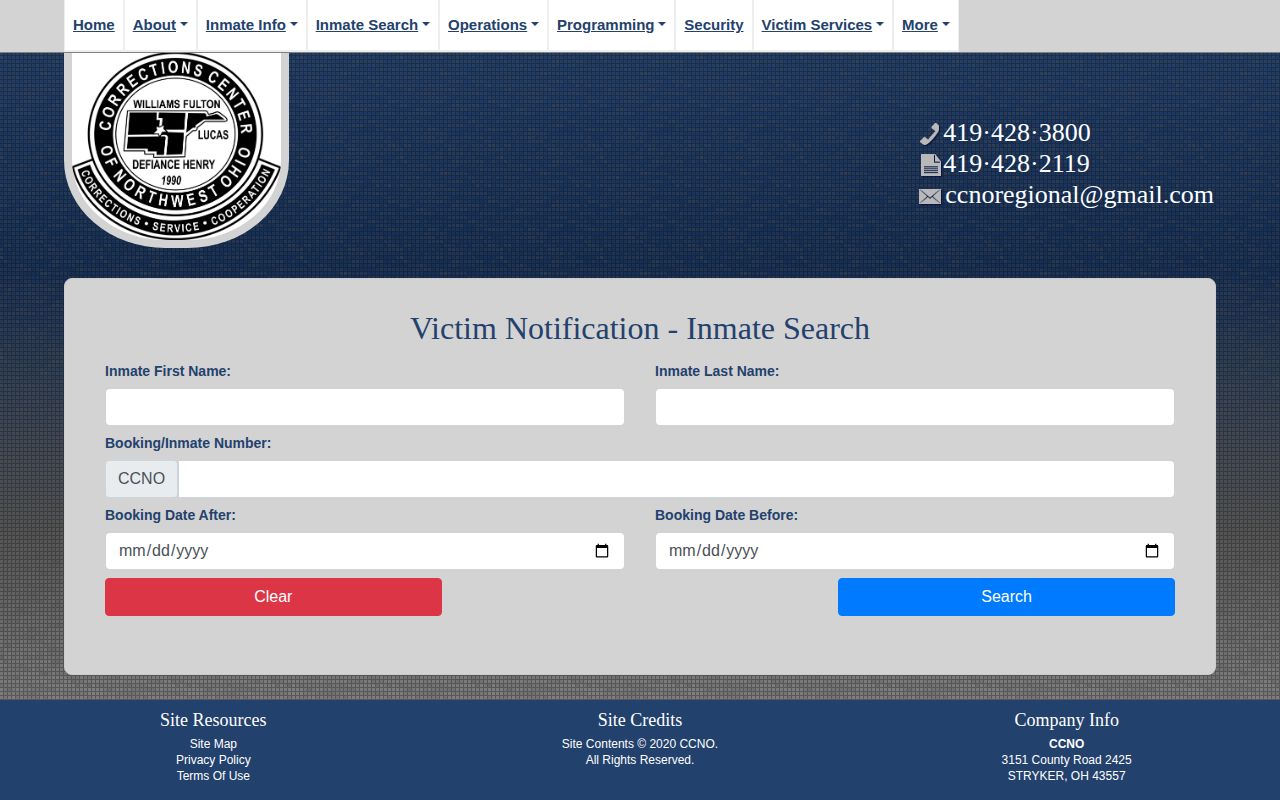
This interface can connect a name to a CCNO booking, but CCNO does not guarantee archive depth. A hit proves a booking, not the final release event.
Williams County Release Court Filters
CCNO's shared population makes the Court and Arresting Agency fields more than labels. They are jurisdiction filters. A Williams County Common Pleas entry points to the county felony docket. Bryan Municipal Court handles relevant misdemeanor and traffic cases as well as felony preliminary stages. An outside-county court label sends the search to that county. A federal label requires a federal route.
The Williams County Common Pleas search gateway can supply the durable legal disposition. Search by party or case number, then read the actual filings and journal entries. Bond, dismissal, sentence, jail-time credit, community control, prison conveyance, judicial release, and case termination each answer a different question. A summary status alone can miss those distinctions.
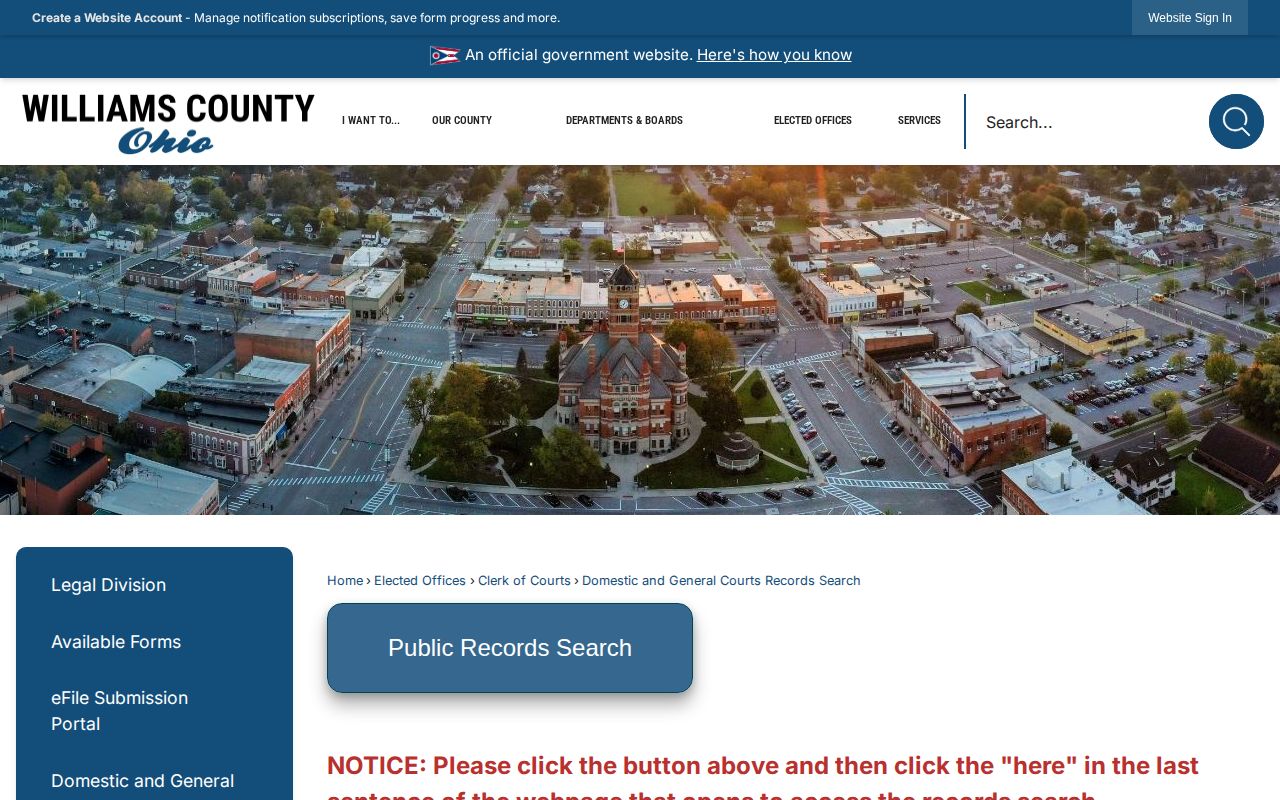
The court image shows where to begin, while the journal entry provides the authority for release. CCNO remains the source for the minute physical custody ended.
Note: One person may have several cases or holders, so release in one docket does not resolve every custody basis.
Ohio Search for Williams County Releases
The Ohio Department of Rehabilitation and Correction Offender Search covers people committed to Ohio prisons and certain people supervised by the Adult Parole Authority. ODRC does not cover someone whose only confinement was at CCNO. Use it after a Williams County court imposed a prison sentence or when a CCNO departure appears to be an ODRC transfer.
| Search field | How to use it | Key limit |
|---|---|---|
| First and last name | Try accurate spelling and known former names. | Name matching may return surnames that begin with the entered letters. |
| Offender number | Enter the prefix and six digits; Ohio uses W for women and A or legacy R for men. | Do not drop the letter prefix. |
| County of Commitment | Choose Williams to find cases committed by a Williams County court. | This differs from where the person later lives. |
| Residential County | Use Williams for a last recorded supervision residence. | It does not prove a Williams County conviction. |
| Status | Filter by Incarcerated, Released, APA Supervision, or Violators at Large. | A supervision status means the person left prison but remains under authority. |
| Hearing month | Enter a Parole Board month in YYYYMM form when relevant. | A hearing date is not a physical release date. |
A detail may show status, institution or supervision office, offense and sentence data, admission dates, jail-time credit, a photograph, and an “Expected Release Date/Parole Eligibility Date” field. Preserve the exact label. A released status plus a supervision start date is stronger evidence that prison custody ended than a projected or eligibility date alone. “APA Supervision” means release from prison under state supervision. “Violators at Large” means ODRC reports an absconding status; any displayed location is only the last recorded address, not a current verified location.
The official Williams County released example pictured below displays a judicial-release status and release-related fields. Judicial release means the sentencing court authorized the prison release, so the Common Pleas journal remains companion evidence.
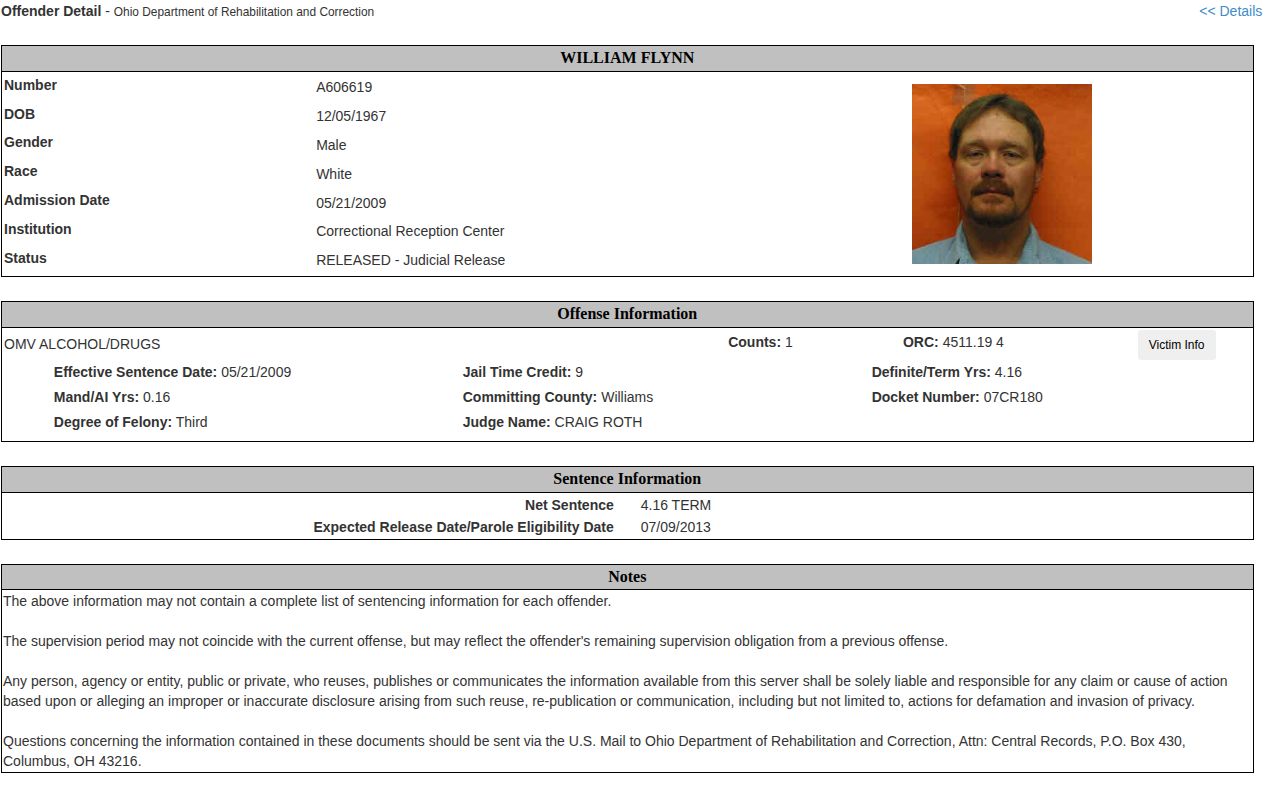
The image was captured July 31, 2026. It demonstrates how ODRC labels a state-prison outcome and should not be used as a model for a CCNO-only release. When the public detail is not enough, use ODRC's public-record request route for a specifically identified public item rather than asking for the entire confidential inmate or APA file.
Williams County Recent Release Limits
Neither CCNO nor the Williams County Sheriff publishes an official list of people released in the last 24 or 72 hours. CCNO does publish previous-day and previous-seven-day booking reports. Those reports describe admission, not departure. The active-offender PDF is also a current-custody snapshot. Its “Estimated Out Date” may be blank or change, and it does not prove that release occurred.
For a same-day or three-day Williams County release question, use the named CCNO search and compare it with the current report. Then check the right court entry and VINE. Call CCNO at 419-428-3800 if the online material is unclear. A records request can ask for releases between exact start and end timestamps, limited where possible to Williams County commitments or arresting agencies. If no compiled list exists, ask for existing release-log fields rather than demanding that staff create a new report.
The active search warns that information changes fast. A current listing supports present reported custody. A disappearance triggers follow-up; it does not state the release type. The dedicated Williams County 24-Hour Release List explains this no-feed fallback for a same-day window.
Note: CCNO's previous-day and seven-day reports list bookings, so neither can be relabeled as a Williams County release feed.
Williams County Release Supervision and Alerts
Local probation and state supervision are separate. Williams County Adult Probation handles court-ordered pretrial release and community control. ODRC's Adult Parole Authority handles parole and post-release control after state prison. A person on CCNO bond may report to the local office without ever being an APA parolee. Verify the order in the docket, then use the correct office.
Ohio VINE through VINELink lets a user search a specific participating custody record and register for status-change notices. CCNO expressly participates and lists 1-800-770-0192. Phone registration uses a four-digit PIN to confirm receipt; email and text follow the choices shown in the portal. Register while the person is in custody because VINE is an alert system, not a permanent archive of all former inmates.
A VINE event can report general release, transfer, escape, or death. Preserve the exact event wording. Data may lag, and a missing result is inconclusive. Confirm a reported release with CCNO, the court, or ODRC. Williams County parole and probation records must be checked through the authority named in the order or offender detail. Ohio's sex-offender registry is separate, applies only when an independent registration duty exists, and does not prove the exact time of release.
Note: A VINE notice corroborates a reported custody change but does not replace a certified release packet or court entry.
Federal Williams County Release Checks
A federal detainee can be housed at CCNO. If the active report shows Federal Court, US Marshals Service, or another federal holder, departure from Stryker may only be a transfer within federal custody. USMS manages many pretrial and in-transit prisoners and has no public released-prisoner locator equal to the BOP tool. Use the federal docket and the appropriate Marshals contact before BOP designation.
For a sentenced federal person, use the BOP Inmate Locator. Search by BOP, DCDC, FBI, or INS number, or by name with age, race, and sex. The locator generally covers records from 1982 forward and updates daily. A past date with location “RELEASED” supports an end to BOP custody. “Not in BOP custody” can also reflect pre-BOP status, another custodian, or a mismatch, so read the federal docket when the path remains unclear.
For immigration detention, the ICE Online Detainee Locator accepts a nine-digit A-number and country of birth or biographical details. It includes current detainees and people released from ICE custody within the prior 60 days, and it excludes people under 18. After that window, a miss proves little. Transfer from CCNO to ICE is continued custody. The official ICE information line is 1-888-351-4024 on weekdays from 8:00 a.m. to 8:00 p.m. Eastern, excluding federal holidays.
Williams County Release Source Comparison
Each source answers one part of the Williams County release question. A current roster shows who is reported in custody now. A release packet states when and how the CCNO episode ended. Court entries explain the legal authority. State and federal systems take over only when those governments have custody or supervision.
| Source | Best evidence | What it cannot prove alone |
|---|---|---|
| CCNO active report | Current reported regional-jail custody and court or agency fields | Why a missing person left the list |
| CCNO historical search and release packet | Booking link, physical release or transfer time, and disposition | The full legal meaning of every court order |
| Williams County or Bryan court docket | Bond, dismissal, sentence, community control, or commitment authority | The exact minute jail processing ended |
| ODRC Offender Search | Ohio prison status, released status, dates, and APA supervision | A CCNO-only release |
| Ohio VINE | Participating custody status and change alerts | A certified release record |
| BOP or ICE locator | Federal prison status or current and recent ICE detention data | A state or county release outside that system |
A reliable finding uses the smallest set that resolves the actual custody chain. If a person vanished from CCNO, identify the jurisdiction, read the court outcome, and check any receiving agency. When the exact release time or type remains missing, request the CCNO packet instead of guessing from a blank search result.
Regional Williams County Release Paths
The defining Williams County fact is regional custody. Corrections Center of Northwest Ohio is the only detention facility in the project facility map. It holds pretrial and sentenced local detainees, people subject to other holders, and some federal placements. A Williams County booking may end in community release, but it may instead move to an Ohio reception center, another county, USMS, ICE, or another lawful custodian.
Work release and electronic monitoring also require care. CCNO says work-release participants spend unauthorized time at the center and provide their own transportation. Electronic monitoring or house arrest follows a court placement and eligibility review, with rules that can last from 15 days to six months. Physical presence outside a jail cell under one of these programs is not the same as unconditional discharge.
Trace the next destination from the CCNO release packet, the court entry, and the receiving agency's system. For a prison commitment, switch to ODRC after reception. For a federal matter, follow the federal chain. When the packet says community release, check whether local probation, APA supervision, or another court condition follows.