
Williams County Projected Versus Actual
A projected date is a forecast built from the current sentence record. An actual release date records the custody event after it occurs. CCNO's active-offender report may show an “Estimated Out Date” for some listed people. It is a planning field for current custody, may be blank, and can change. It does not prove departure. The CCNO release packet supplies the actual date, time, disposition, and public transfer information.
Pretrial custody works differently. Before a sentence, there may be no term from which to calculate an end date. Release can follow bond, recognizance, dismissal, a plea and sentence, or another judicial order. A separate holder can prevent community release even after one court acts.
- Jail-time credit
- Days the sentencing court credits for qualifying confinement already served.
- Parole eligibility
- The first point at which an eligible person may be considered, not a promised release.
- Judicial release
- A release authorized by the sentencing court under the applicable law and order.
- Detainer
- A hold or request from another authority that can lead to transfer instead of community release.
Find Williams County Projected Release Dates
Identify the current custodian before searching. CCNO serves five counties and can hold local, state-bound, and federal detainees. Its Court and Arresting Agency fields help isolate a Williams County matter. Once a person is transferred into ODRC, the CCNO estimate stops being the controlling prospective field.
- Check the CCNO active report. Presence means current reported custody. Record the booking number, court, case, status, and any Estimated Out Date.
- Read the Williams County sentencing entry. Confirm the term, jail-time credit, concurrent or consecutive structure, and later modifications.
- If the person entered state prison, use the ODRC Offender Search. Search by the prefixed six-digit offender number when known.
- Quote ODRC's date label exactly. “Expected Release Date/Parole Eligibility Date” joins concepts that must be interpreted from the sentence and status.
- Check for a holder, parole decision, judicial-release order, or recalculation. Then ask CCNO, ODRC, or the court for the current authoritative result.
ODRC offers County of Commitment and Residential County filters. Selecting Williams as the committing county points to a Williams County court commitment. Selecting Williams as residential county concerns the last recorded residence for a supervised person. It does not identify the sentencing court.
The ODRC offender-search interface displays these search controls.
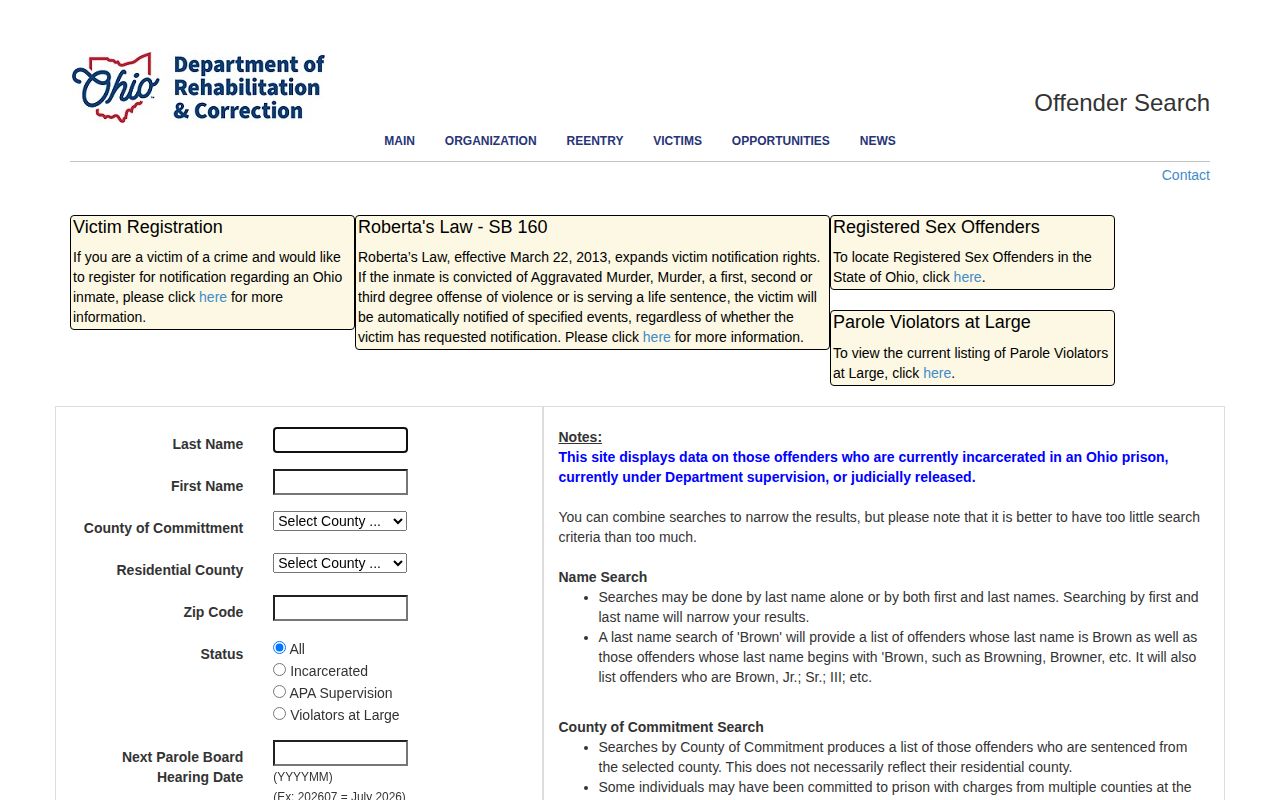
The live detail page, sentence, and status must be read together because a screenshot is only a navigation aid captured at one time.
Williams County Prison Release Computation
ODRC begins with the sentencing entry. The calculation can include definite, minimum, and maximum terms; jail-time credit; concurrent and consecutive terms; statutory credits; later court orders; and the release authority. Ohio rules differ by sentence generation. Under OAC 5120-2-03.2, some pre-Senate Bill 2 terms may receive up to seven days per month, Senate Bill 2 terms may receive one day per month, and qualifying House Bill 86 or Senate Bill 201 components may receive one or five days per month. Mixed consecutive terms are computed in an ordered sequence.
The sentencing court supplies jail-time credit. OAC 5120-2-04 directs ODRC's computation function to apply the court's figure. A corrected entry can therefore change the projected release date. CCNO's local jail estimate does not authorize applying prison-credit formulas to a local term.
ORC 2967.194, applicable under its current framework beginning April 4, 2024, allows eligible people provisionally to earn one or five days per completed month for approved productive participation, with a possible additional five days for a second qualifying activity. A qualifying achievement can yield separate credit of 90 days or ten percent of the stated term, whichever is less. Awards face exclusions, review, denial, and withdrawal.
The ordinary 15 percent cap sometimes produces an “about 85 percent” shorthand. It is not a universal Ohio rule. Mandatory portions and several offense or sentence types cannot be reduced in the same way. Rule violations can also cause credit to be denied or withdrawn.
Current law excludes or limits credits for several categories, including death sentences, aggravated murder or murder terms, life without parole, specified Chapter 2971 terms, certain sexually oriented offenses, and terms that the law makes non-reducible. Mandatory time generally remains mandatory. Productive-participation credit is provisional until reviewed and awarded. That is why subtracting a flat percentage from a Williams County sentence is not a sound date calculation.
Achievement credit and monthly participation credit are also separate concepts. The record must show that the person and activity qualify. A program enrollment alone does not prove that credit has been earned, approved, or applied. ODRC and the sentencing court hold the source records needed to resolve a disputed figure.
Williams County Release Date Changes
A displayed date is based on the record known at that time. New court entries, credits, sanctions, or holds can move it. A parole decision can also affect the expected path without proving that release has taken place.
| Change | Effect on the date | Source to check |
|---|---|---|
| Corrected jail-time credit | Moves the computation when the court changes qualifying days | Sentencing court and ODRC |
| Consecutive sentence | Adds a term in the required order | Journal entries and ODRC |
| Earned credit award or loss | May reduce time or restore a later date | ODRC calculation |
| Judicial release | Can authorize an earlier court-controlled release | Common Pleas journal and ODRC status |
| Parole action | Grant, denial, deferral, or rescission changes the path | Parole Board and ODRC |
| Detainer or holder | May cause transfer rather than community release | Custodian and issuing agency |
A parole grant may carry a future effective date and conditions. Denial keeps the person confined until another review or sentence event. A rescinded grant no longer authorizes the expected release. Confirm physical departure through ODRC status after the effective date.
Confirm Williams County Actual Release
For CCNO, call 419-428-3800 when the online report is unclear and request the booking or release packet. Ask for admission and departure time, release type, releasing authority, and public transfer destination. For a state prisoner, recheck ODRC status and supervision fields. “Released” or “APA Supervision” is stronger evidence of departure than a future date alone. The full custody-search and records sequence is on the Williams County home page.
For a county sentence, the Common Pleas or Bryan Municipal Court docket may contain the definite term, bond action, modification, or jail-time-credit entry. It may not state the exact minute that CCNO processed departure. Record the court date and facility departure time separately. If the court orders prison, the person leaves CCNO for state reception rather than the community.
Ohio VINE can add notice of a reported event. Register before the expected date and preserve the exact wording. A transfer alert is not a release alert, and VINE may lag. Instructions for phone, text, and email registration appear in the Williams County VINELink check.
Ohio Indefinite Release Calculations
Risk-reduction sentences and Senate Bill 201 indefinite terms require separate analysis. Under ORC 2929.143 and OAC 5120-2-14, an eligible court-imposed risk-reduction sentence uses all mandatory time and at least 80 percent of aggregated nonmandatory time, reduced by jail credit. A person serving it does not also receive ordinary earned credit for the same term.
Under ORC 2967.271, a non-life Senate Bill 201 indefinite term carries a presumption of release at the minimum term or statutory presumptive earned early release date. ODRC may rebut that presumption through the statutory process and retain the person up to the maximum. A lone projected date cannot show whether that process will occur.
For parole-eligible life or older indefinite terms, eligibility means an opportunity for Board review. It is not an automatic release. Read the monthly calendar, decision, current ODRC status, and later supervision start date as separate pieces.
A stable ODRC Williams County example demonstrates the fields without supplying a rule for anyone else. The official print view for offender number A606619 identifies Williams as the committing county, lists docket 07CR180, and displays “RELEASED - Judicial Release,” jail-time credit, an aggregate sentence, a photograph, and an Expected Release Date/Parole Eligibility Date. It shows how status and court action clarify a combined date label. It must not be used to estimate another person's term.
CCNO Williams County Date Limits
CCNO's Estimated Out Date belongs to its active population report. It may help frame a question about a sentenced local term, but no researched source promises that the field incorporates every court change, hold, or later event in real time. A blank field is not proof of an indefinite sentence.
ORC 2929.24 permits a court to impose definite misdemeanor jail terms and retain power to modify a nonmandatory local jail sentence. Start with the court's exact order and jail-time credit. Ask CCNO or the court about an authorized change. Do not import ODRC's prison-credit rates into the regional jail calculation.
After a Williams County prison commitment, most male transferees first go to the Correctional Reception Center and female transferees to the Ohio Reformatory for Women. Reception is not final placement or community release. From that point, ODRC controls the prison date.
Audit Williams County Release Calculations
A useful date review begins with the sentencing court, not a percentage applied to the term. Under OAC 5120-2-04, the court supplies jail-time credit and ODRC's computation function applies it. Compare the judgment, any later correction entry, each consecutive or concurrent component, and the exact date label on the current ODRC detail. A stale printout cannot resolve a later recalculation.
If the numbers still conflict, identify the Williams County case number and ODRC number before asking for review. ODRC directs sentence-record questions to Central Records at P.O. Box 430, Columbus, OH 43216. Request a specific public item or correction path because full inmate and APA files are restricted by ORC 5120.21. The court clerk remains the source for certified sentencing entries.
The final check occurs after the predicted day. ODRC status, a supervision start date, a court order, or the facility's actual release record can establish what occurred. A date that passed without a status change should be treated as an old estimate, not proof of release.