
Williams County Three-Day Releases
Neither the Williams County Sheriff nor the Corrections Center of Northwest Ohio publishes a list of releases from the last 72 hours. CCNO offers an active-offender report, a previous-day booking report, and a previous-seven-day booking report. Those products describe current custody and admissions. They do not state who left in a three-day release window.
A three-day range is still useful as a request frame. It can cover a weekend, a county holiday, or a period when the search was not checked each day. Set exact start and end timestamps rather than asking for “recent releases.” The exact range helps CCNO identify existing release-log fields while preserving the true event date, even if an online source changed later.
CCNO serves five counties, so a regional result also needs a Williams County tie. Review the arresting agency, court, case number, and booking number. A record assigned to another member county or a federal court does not become a Williams County release merely because the jail is in Stryker.
Check Williams County 72-Hour Releases
The search begins with custody type, not with an assumption that every missing person went home. A local Williams County case follows CCNO and the issuing court. A prison commitment follows ODRC after transport. A federal placement follows the federal docket, USMS, and BOP. Each route can explain a departure from the regional roster.
- Write down the exact three-day range, including time zone and start and end times. Keep the same range in each check.
- Use the CCNO named booking search. Enter the full name, booking number when known, and useful booking-date bounds.
- Compare a matching booking with the current CCNO search. An active result points to current reported custody, while a missing result still needs an outcome.
- Follow the listed court. Read Williams County Common Pleas journal entries or the Bryan Municipal Court record for bond, dismissal, sentence, release, or prison commitment.
- Check VINE for a reported custody-change event, then call CCNO at 419-428-3800 when sources conflict or the web record is unclear.
- Request existing release-log or packet fields for the exact range. Ask CCNO to state the departure timestamp, disposition, authority, and public transfer destination.
The Williams County 24-Hour Release List is better for a same-day check. It uses the same official sources but narrows the request window and focuses on a just-processed event. Neither page treats the live roster as a historical release archive.
Note: Record each portal's as-of date because a Monday view may no longer match the population shown during the weekend.
Williams County Three-Day Record Fields
Since no public three-day release table is posted, ask for fields that can establish the event without forcing CCNO to compile a new report. The release packet links the person, the precise booking, the authority for departure, and any continued custody that may be public. The court record supplies durable legal context but may not show the minute staff completed discharge.
| Requested field | Why it matters |
|---|---|
| Name and CCNO booking number | Separates the correct episode from similar names or repeat bookings |
| Admission date and time | Confirms the starting point of this custody episode |
| Release or transfer date and time | Places the physical departure inside or outside the 72-hour range |
| Release type or disposition | Distinguishes bond, sentence completion, court release, or transfer |
| Releasing authority | Points to the court or agency record that should agree |
| Public transfer destination | Shows whether another custodian received the person |
| Case and arresting agency | Identifies whether the booking belongs to Williams County |
CCNO's active report has an Estimated Out Date for some rows. That field is a forecast for a person still listed. It can be blank or change and does not prove that departure occurred. A release timestamp is retrospective. Keep the labels distinct.
Williams County Weekend Release Checks
Research found no published CCNO weekend release schedule, public exit location, family waiting area, transit plan, or special holiday processing rule. Do not infer one. The value of a 72-hour range is records coverage: it spans three calendar days even when an office counter is closed or a person checking the site misses a day.
Court action and physical release can fall on different timestamps. A judge may sign a bond or release order before jail staff complete identity checks, review other holds, return property, and finish discharge. Keep the journal date and the CCNO departure time as separate facts. If a second court or holder remains, one signed order may not result in release at all.
For one named person, the Williams County released inmate lookup explains how to reconcile CCNO, the court, ODRC, VINE, BOP, and ICE. That person-specific route is more useful than a broad three-day request when the goal is to confirm one outcome.
Note: No source promises that a weekend event will appear online by the next business day, so confirm it with the custodian.
Request Williams County Three-Day Records
CCNO accepts inmate-record requests by email at ccnoregional@gmail.com, by phone at 419-428-3800 ext. 201, by mail, and in person. Its records hours are Monday through Friday from 8:00 a.m. to 4:00 p.m. The stated copy price is $0.25 for each single-sided letter-size page. Ask whether electronic delivery changes the cost before ordering.
A focused request can say: “Please provide a list or existing records sufficient to show all releases from CCNO between [start timestamp] and [end timestamp], limited where possible to Williams County commitments or arresting agencies, with booking number, release timestamp, and release disposition. If no compiled list is maintained, please provide responsive existing release-log fields.” This wording asks for kept data rather than a custom analysis.
Ohio Revised Code 149.43 governs nonexempt public records and allows the office a reasonable production period. It does not set a universal number of days for every release request. Protected medical, investigatory, witness, personal identifier, and security material may be redacted. Ask for the statutory basis when part of the response is withheld.
Sheriff Thomas Kochert's office is the route for sheriff-created arrest, incident, or transport material. CCNO remains the source for its custody and release packet. ODRC records follow a different confidentiality statute, so a request for a state-prison file cannot simply be sent through the county-jail process.
Williams County Booking Window Trap
CCNO's most prominent recent reports are admission products. One covers the previous day, and another covers the previous seven days. Seven days is not 72 hours, and a booking is not a release. Trimming rows by date cannot fix that mismatch because the report still measures entry into custody.
The official CCNO booking-report screen shows both available period choices.
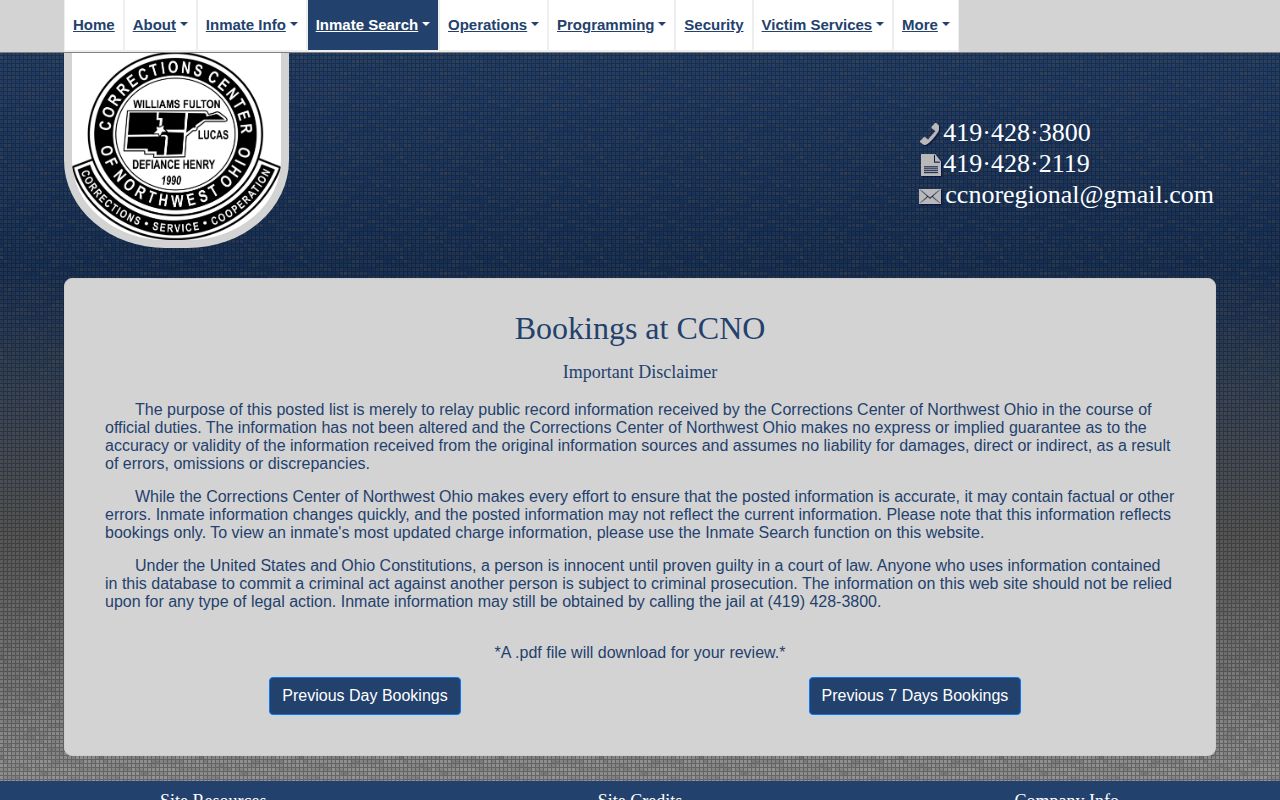
The image supports navigation to the official reports. It does not change their scope, and it must not be captioned or counted as a three-day release source.
A booking row can include name, booking number, admission time, demographics, arresting agency, charge, status, severity, court, and case. These fields help locate the right person and jurisdiction. They reveal nothing conclusive about whether that person later bonded out, completed a term, remained held, or transferred during the requested range.
Williams County Release Outcome Tests
Use the event type as the final test. A community release may follow bond, recognizance, time served, sentence expiration, dismissal, or another judicial order. A state commitment can remove the person from CCNO while ODRC begins custody. A federal or immigration holder can also cause a physical move without freedom.
- Community release
- CCNO custody ended and the record identifies a release rather than another custodian.
- Transfer
- The person left CCNO but remained in government custody with ODRC, another county, USMS, ICE, or another holder.
- Bond
- Physical custody ended while charges and court conditions continued.
- Post-release control
- The person left state prison but remains under Ohio Adult Parole Authority supervision.
VINE can add a reported event. Its labels distinguish general release, transfer, escape, and death. Preserve the label and confirm it with CCNO, ODRC, or the court. Do not turn every custody change into “released to the community.”
The ODRC Offender Search is appropriate only after a prison commitment or for later state release. It does not cover a person whose only custody was at CCNO. The BOP locator handles sentenced federal records, while ICE ODLS has its own scope and time limits. System boundaries remain important even within a broad 72-hour review.