
Where CCNO Releases Go
The Corrections Center of Northwest Ohio is a regional jail, not a Williams County-only jail. A person may leave CCNO for the community after bond, recognizance, dismissal, time served, local sentence completion, or another court order. The same person may instead transfer to an Ohio Department of Rehabilitation and Correction institution, another county, USMS, ICE, or another lawful holder.
A release record must name the outcome. The CCNO packet supplies the physical departure date and time, release or transfer disposition, and public destination when available. A Common Pleas or Municipal Court journal supplies the legal authority. Read both. An order may be signed before staff finish identity checks, review holds, return property, and close the custody episode.
| Departure path | Best confirming record |
|---|---|
| Bond or recognizance | Court order plus CCNO physical release timestamp |
| Time served or sentence completion | Sentencing entry and CCNO release disposition |
| ODRC prison commitment | Court sentence, CCNO transfer record, and ODRC incarcerated status |
| Federal or other holder | CCNO transfer field and receiving authority's record |
| Community control | Court order and local probation terms |
Bond release ends jail custody but not the case. Community control is a court sentence or condition outside jail. State parole and post-release control apply after prison and fall under ODRC's Adult Parole Authority. Those labels should not be swapped.
Confirm a CCNO Release
Start with identifiers that can separate repeat bookings and similar names. The CCNO booking number is the strongest local key. Then follow the jurisdiction fields because the regional database combines cases from Defiance, Fulton, Henry, Lucas, and Williams counties, along with some federal placements.
- Open the CCNO historical search. Enter first and last name, then add the booking number or booking-date bounds when known.
- Compare the result with the active-offender search. Presence supports current reported CCNO custody. Absence only shows that the current list lacks the person.
- Read Court and Arresting Agency. Follow Williams County Common Pleas for its cases, Bryan Municipal Court where shown, or the listed outside authority.
- Check VINE for the reported event wording. General release, transfer, escape, and death are distinct events.
- Check ODRC after a prison commitment. Use the federal docket, USMS chain, and BOP for a federal departure.
- Call CCNO and request the booking/release packet when the exact departure time, disposition, or destination matters.
The Williams County released inmate search provides the broader route across jail, court, state, and federal records. For CCNO itself, the active list is a current-custody tool. It must never be presented as the source of completed release history.
The successful manifest capture of the CCNO active search shows the facility's current-search entry point.
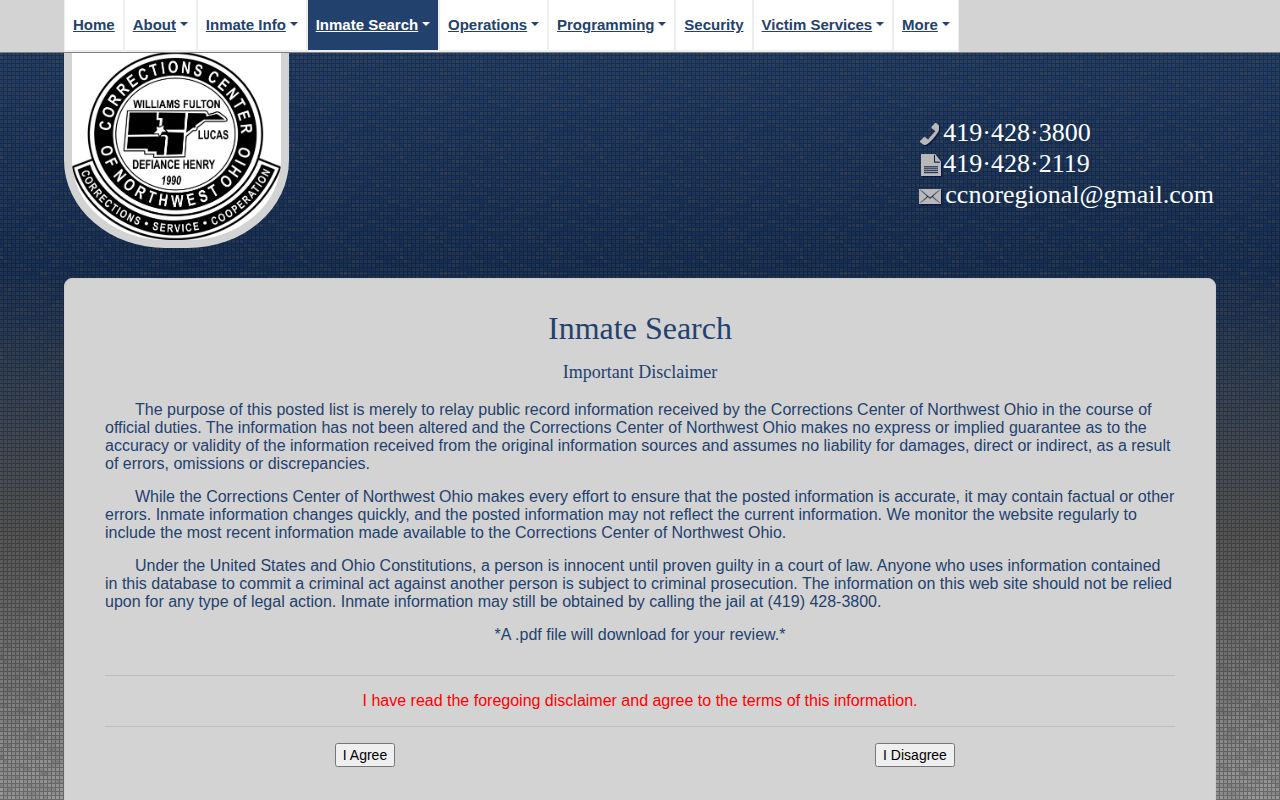
This interface was captured July 31, 2026 and helps establish current reported custody. A completed CCNO release still requires the historical, court, VINE, or records-request path.
Note: Keep the online report's as-of time because a later CCNO snapshot may reflect a different custody status.
CCNO Release Records Contact
CCNO states that inmate records are public records subject to Ohio law and listed exemptions. A precise request should name the person, booking number, approximate admission date, and the exact fields needed. Ask for admission and release or transfer timestamps, release disposition, releasing authority, public transfer information, and the booking photograph if relevant.
Corrections Center of Northwest Ohio03151 County Road 2425
Stryker, OH 43557
Phone: 419-428-3800
Records extension: 201
Administration fax: 419-428-2119
Email: ccnoregional@gmail.com
Records hours: Monday through Friday, 8:00 a.m. to 4:00 p.m.
Requests are accepted by email, mail, phone, or in person. CCNO lists $0.25 for each single-sided letter-size copy and says records will be available at cost within a reasonable period. Ask whether electronic production changes the charge. Ohio Revised Code 149.43 does not promise a single turnaround for all requests.
Protected medical facts, confidential law-enforcement investigatory material, source or witness information, Social Security numbers, security facts, and records barred by other law may be redacted. Ask CCNO to cite the basis for any withheld portion. Narrowing the request to one booking and named fields helps avoid an overbroad response.
CCNO Regional Jail Profile
CCNO is operated by the Corrections Commission of Northwest Ohio. The commission formed in 1987, and operations began in 1990. CCNO describes itself as Ohio's first regional jail. It holds pretrial detainees, sentenced local inmates, holders, transfers, and other authorized detainees. Federal labels also appear in active records.
The official 2025 facility statistics report 4,602 bookings, 4,520 releases, an average population of 560, 576 funded beds, and an average stay of 35.74 days. All five figures describe CCNO as a whole. They are not Williams County-only totals and must not be divided or extrapolated into a local release count.
Separate population figures put Williams County's 2025 average daily population at 46, including 39 men and 7 women, with 55 funded beds allocated to Williams. These are population and allocation facts, not a release count. They also do not identify any person's status.
CCNO Regional Release Jurisdiction
Regional custody is the defining CCNO fact. A person booked for Williams County can appear beside people held for Defiance, Fulton, Henry, Lucas, or federal authorities. The location of the building does not establish which county controls the case. Always capture the Court, Arresting Agency, case number, and booking number before following another source.
A disappearance from the shared roster creates several live possibilities. It could reflect a true community release. It could also reflect a move to a member county, ODRC, USMS, ICE, or another holder. The release packet decides which departure CCNO recorded, while the receiving system shows whether custody continued.
For a Williams County felony, the Common Pleas docket is the durable source for the sentence, bond order, dismissal, judicial release, or prison conveyance. Bryan Municipal Court handles relevant misdemeanors, traffic matters, and felony preliminary stages. Sheriff Thomas Kochert's office supplies sheriff-created arrest or transport records. If CCNO shows an outside court, use that jurisdiction rather than forcing the booking into the Williams County path.
Note: A CCNO booking is regional evidence; Williams County jurisdiction comes from the case, court, and arresting-agency fields.
CCNO State Prison Transfers
A Williams County prison sentence can end the CCNO placement without releasing the person to the community. CCNO says most male ODRC transferees first go to the Correctional Reception Center in Orient, while female transferees first go to the Ohio Reformatory for Women in Marysville. Reception is intake, not final placement and not freedom.
Once ODRC receives the person, its offender search becomes the controlling public status route. CCNO's Estimated Out Date no longer controls. ODRC may show an institution, incarceration status, committing county, sentence data, jail-time credit, and an Expected Release Date/Parole Eligibility Date label. A future or eligibility date is not proof of actual departure.
A sound transfer finding reads in sequence: the Williams County court imposed prison, the person departed CCNO under that commitment, and ODRC shows incarceration. If ODRC later shows Released or APA Supervision, report that later state-prison event separately. Judicial release requires the court journal for its order and conditions.
CCNO Transfer Property Rules
CCNO's published prison-transfer rules add a practical distinction between transfer and ordinary community discharge. The facility says no money or personal property travels with a person to ODRC. Someone awaiting transport should authorize pickup. The Property Master tries to reach family or a friend about items left behind.
Under that transfer policy, property remaining after departure is disposed of after 60 days. Prescription medication is available for pickup and destroyed after 30 days. An unforwardable trust-account check is held for two years before transfer to the inmate trust fund under facility policy. These deadlines are specific to the documented prison-transfer setting. Confirm with CCNO before applying them to a community release.
Booking staff inventory personal property, receipt inmate money, and place clothing in a property bag. For a discrepancy, contact CCNO with the booking number and receipt. Do not invent a weekend pickup rule or assume that property left after one kind of departure follows the same procedure as an ODRC transport.
CCNO Community Release Boundaries
Physical presence outside a cell does not always mean unconditional discharge. CCNO work-release participants serve non-authorized time at the facility and provide their own transportation. Electronic monitoring or house arrest follows court placement and an eligibility review, then imposes stated limits in the community.
CCNO says electronic monitoring can last from 15 days to six months. Participants pay monitoring charges unless indigent, but no rate was published. The court order and community-corrections record therefore matter as much as physical location. A work-release participant can be outside for approved activity while still serving time at CCNO.
- Release
- The facility's custody ends under a stated legal authority.
- Work release
- Approved time outside occurs while the person remains in the CCNO program.
- Electronic monitoring
- Court-approved community placement continues under set restrictions and review.
- Transfer
- The CCNO episode ends because another custodian receives the person.
These distinctions prevent a roster change or physical absence from being overstated. The release or transfer disposition, court order, and receiving-agency record should agree before the outcome is described.