
Williams County Parole Versus Probation
Williams County Adult Probation and Ohio's Adult Parole Authority perform separate roles. Adult Probation handles supervision ordered in a Williams County Common Pleas matter, including community control and some pretrial release. Community control is a court-ordered set of rules served in the community instead of, or after, local confinement. APA handles parole and post-release control after an ODRC prison term. Parole is discretionary release under authority of the Ohio Parole Board for an eligible sentence. Post-release control is a statutory period of supervision that may follow a prison term.
A person released on bond from the Corrections Center of Northwest Ohio may have to report to Adult Probation while the case is open. That does not make the person a parolee. Likewise, someone shown as released by ODRC may remain on APA supervision. Physical release and the end of legal control are separate events.
| Williams County status | Source of authority | Best verification |
|---|---|---|
| Pretrial release or bond | Municipal or Common Pleas court order | Court docket, then Williams County Adult Probation |
| Community control or probation | Williams County sentencing entry | Journal entry and Adult Probation procedure |
| Parole | Ohio Parole Board and ODRC | ODRC offender detail, Board record, and APA |
| Post-release control | Ohio law and sentencing record | ODRC status, sentence, and APA office |
- Discharge
- The formal end of a supervision term, not merely release from a jail or prison.
- Absconder
- A supervised person alleged to have stopped reporting or left supervision without permission.
- Detainer
- A request by another authority to hold or transfer a person instead of releasing that person to the community.
Check Williams County Release Supervision
Begin with the legal source that created the supervision. A Williams County court docket controls a local probation or community-control order. ODRC controls the public status of a person released from state prison. CCNO's active report cannot answer either question after a person leaves its custody. Because CCNO serves five counties, also verify the court and arresting agency fields before treating a booking as a Williams County case.
- Find the Williams County case number in the Common Pleas or Bryan Municipal Court record and read the most recent journal entry.
- For a prison case, search the ODRC Offender Search by offender number when possible. Check status, committing county, supervision dates, and APA office.
- Distinguish “Released” from “APA Supervision.” A released status confirms the prison custody change, while APA Supervision states that departmental control continues.
- Compare the court order with ODRC. A supervision duty can arise from an older offense, so one displayed offense may not explain every obligation.
- Contact Williams County Adult Probation for local procedure or the APA field-services route for state supervision. Only the responsible office can confirm current reporting instructions.
The ODRC form can filter by County of Commitment or Residential County. Those fields are not interchangeable. “County of Commitment = Williams” points to a Williams County court commitment. “Residential County = Williams” concerns the last recorded residence for a supervised person and does not prove the conviction arose here. Name searches can also return longer names that begin with the typed letters.
Use an ODRC number when available. The definitions require a letter prefix and six digits. Current records use W numbers for women and A numbers for men, with legacy R numbers also possible for men. Status choices include Incarcerated, Released, APA Supervision, and Violators at Large. Read the status beside the date fields. A release or parole-eligibility date without the current status can describe a plan rather than an event.
The official ODRC search form shows the fields used to narrow a Williams County supervision check.
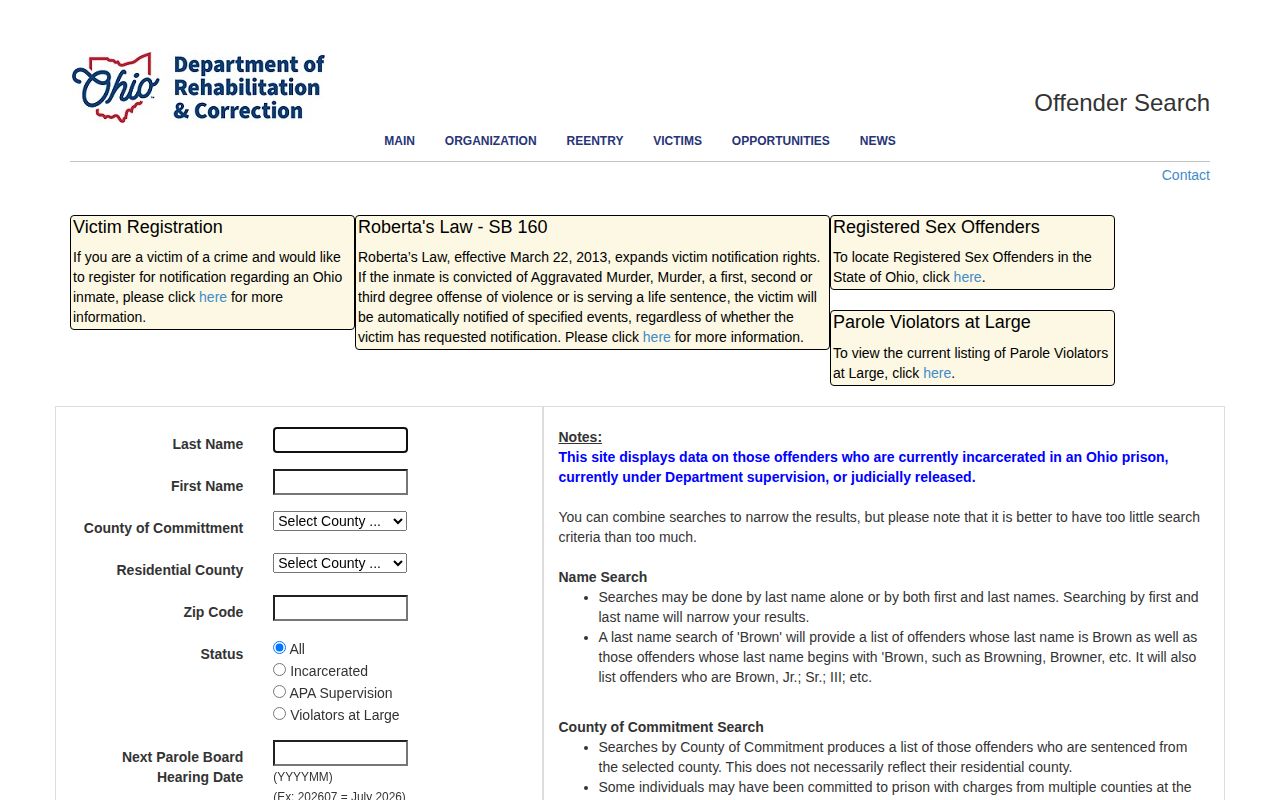
The current portal remains the authority because status, office, and supervision data can change after a screenshot is captured.
Williams County Probation Contact
The Williams County staff directory lists Adult Probation at 419-636-4722. Call after checking the docket, and have the case number ready. The office may explain public procedure, but protected case notes and private supervision details are not promised for disclosure. The Williams County Common Pleas Adult Probation programs page also describes pretrial release, bond supervision, and court restrictions such as reporting and no-contact terms.
Williams County Adult Probation
Phone: 419-636-4722
Authority: Williams County Common Pleas Court
Use: Local pretrial release, community control, and probation procedure
For parole or post-release control, use the ODRC Adult Parole Authority and the office shown in the offender detail. ODRC does not publish full APA case files as ordinary public records. ORC 5120.21 protects institutional and APA records while allowing selected public information through official channels.
Williams County Supervision Violations
Conditions vary with the order. They may include reporting, travel limits, treatment, no-contact directions, or compliance with other court terms. A violation allegation is not the same as a final violation finding. Review the docket for a filed violation, warrant, hearing, or revocation entry, then ask the issuing court or APA about the current public status.
ODRC uses “Violators at Large” for an offender described under ORC 2967.15 as having absconded. The displayed location is only the last address reported before that status. It is not a verified present location. A warrant or declared-violator label also does not erase the earlier release; it signals alleged noncompliance and possible return to custody.
Ohio VINE may send notice of some custody or parole events, but it is not a warrant database. The ODRC record, court docket, and responsible supervision office remain the core sources.
Williams County Supervision Discharge
Supervision ends through a formal action, not merely the passage of a date shown online. A local probation term ends under the court's order and journal record. State parole or post-release control ends through ODRC or APA discharge. A person can therefore be out of CCNO, out of prison, and still subject to supervision until the responsible authority records discharge.
For parole-eligible cases, the Ohio Parole Board posts monthly hearing calendars and decision materials. “Granted” means release is authorized subject to an effective date, conditions, and later events. It does not prove physical departure. “Denied” continues custody. “Continued” or “deferred” delays action, while “rescinded” withdraws a prior grant. Recheck ODRC after the effective date. The Williams County release search and record path on the home page can establish the earlier custody event.
ORC 2967.13 sets differing parole-eligibility rules for specified life and indefinite sentences. There is no single waiting period for every Ohio prisoner. Many people with determinate sentences leave prison under sentence law and then enter post-release control governed by ORC 2967.28.
A Williams County judicial release needs two records. ODRC may display a released status and identify judicial release, while the Common Pleas journal supplies the order and its effective terms. If APA or court supervision follows, the person has left prison but has not finished every legal duty. Judicial release also does not dismiss the conviction or seal the case. Keep the prison-release date, supervision start, and later discharge as distinct entries.
ODRC details may show a Supervision Start Date, Period of Supervision, APA office, and conditions. Some parole records also show the next Board review month, latest hearing type and result, or a POA/PRD date. POA means “parole on or after,” while PRD means projected release date. A POA date is an earliest authorized point for release to supervision, not proof the person left prison on that date.
Williams County Release Property Issues
CCNO records property at booking. Staff inventory personal items, receipt money, and place clothing in a property bag. That record can matter after a Williams County release if property or funds appear to be missing. Contact CCNO with the person's exact booking number and any receipt. Ask the facility to identify its record of what entered custody and what was returned.
No researched CCNO source states a general pickup deadline for property left after a community release. Do not borrow the separate deadlines published for a transfer to ODRC. Those prison-transfer rules address property that CCNO does not transport with the person and may not govern a routine community discharge. The safe route is a prompt, booking-specific inquiry to CCNO.
The CCNO booking and property description is the source for the inventory and receipt process. A supervision officer may direct compliance with a release plan, but the jail remains the right custodian for a booking-property discrepancy.
Keep court control distinct from jail custody as well. CCNO work release lets a participant leave for authorized activity while serving all other time at the center. Electronic monitoring or house arrest follows court placement and an eligibility review. A person may be physically away from a cell yet still be under a custodial or court program. Check the order and CCNO status before describing that arrangement as an unconditional release.
Property questions can also help identify a mistaken custody assumption. CCNO publishes separate rules for people transported to prison. The center says it sends no money or personal property with an ODRC transferee, asks the person to authorize pickup, and holds remaining property while the Property Master tries to reach family or a friend. Those facts describe a transfer, not a community release. Verify the departure type before applying any transfer procedure.